Source Auto Parts from China Without Walking the Trade Show (2026)
You do not need to walk Canton Fair, AAG in Guangzhou, or Automechanika Shanghai until your feet give out. Compare a China trip with RFQ, sampling, QC, and consolidation.
Share this guide
Table of Contents
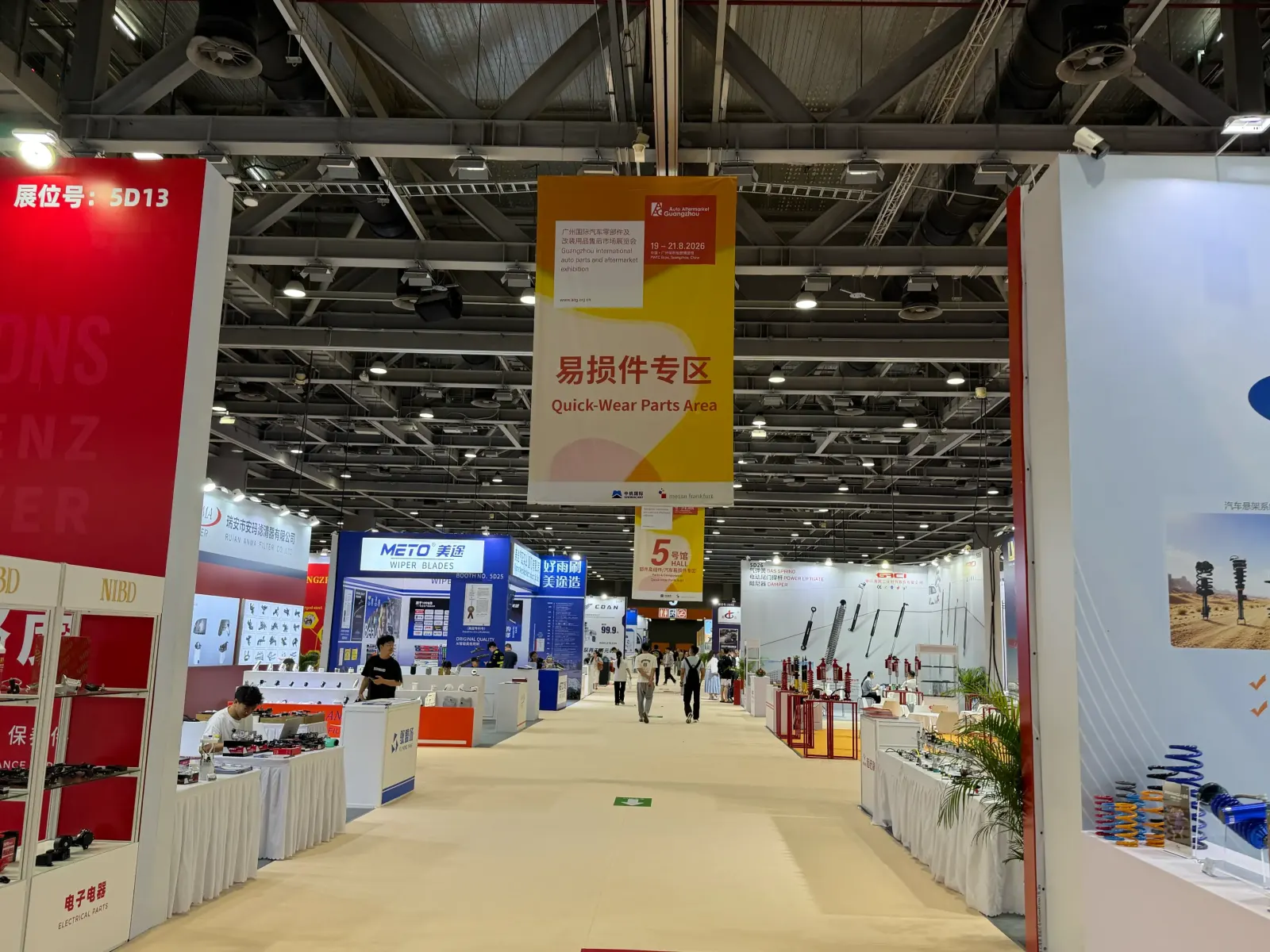
Every spring and autumn, buyers fly into Guangzhou, take the metro toward Pazhou, and walk Canton Fair. In August, Auto Aftermarket Guangzhou (AAG) fills the Poly World Trade Expo Center with replacement parts, commercial-vehicle components, remanufacturing, and other aftermarket stands. Automechanika Shanghai does similar work later in the year. The halls are useful. They are not a purchasing system.
If you run a warehouse in Dubai, a shop in Almaty, a distributor in Moscow, or a repair group in Texas or Poland, the scarce resource is not another business card. It is time away from stock, staff, and customers. You do not have to walk until your feet and back give out. You can send a parts list to a team that already works in China.
Wanting to see a factory with your own eyes is reasonable. Treat that as a later decision, after quotes and samples exist, not as the only way to start.
This is part of the same buying path as How to Buy Auto Parts from China. Trade shows sit in how to find manufacturers. The question here is narrower: do you need to walk the floor yourself?
Walking the floor is a discovery method, not a purchase
A fair week can give you:
- First meetings in English or with a translator at the booth
- A sample on a table, which is not the same as your OE number on your vehicle
- A sense of who bothers to exhibit this season
It does not give you:
- Confirmation that the booth company is the factory that will produce your order
- Quotes on the same specification, quantity, Incoterm, and packaging
- A dated, approved sample against your photos and dimensions
- An inspection standard before mass production
- Carton marks, pallet plan, and cargo data for one mixed container
- Destination classification, duty, or market documents (those stay with you and your broker)
Booth size is a poor proxy for capability. Large exporters and trading groups buy prominent space. Smaller manufacturers share a booth or send a sales company. Ask which process runs in their own facility, then verify later with supplier and factory verification.
Ten minutes at a stand is a conversation. A replenishment order is a file: OE list, market version, sample, AQL, packaging, and a release decision.
What a trade-show week usually costs you
Skip invented airfares. The bill is still real:
- Visa, flights, hotels, and days when the owner is not at the counter
- Jet lag before you have entered the first hall
- A translator or a colleague who can read a Chinese business license
- Follow-up on WeChat after you fly home, which is where many fair contacts go quiet
- The same RFQ, sample, and inspection work you would have done without the trip
After about 30 booths, notes blur. If you go, score each meeting the same day. If you cannot spare a week, do not treat that as a weaker way to buy. Owner-run wholesalers from the Gulf, Central Asia, and Eastern Europe often cannot leave the shop for ten days. That is an operating constraint, not a lack of seriousness.
A fair is a crowded room. Your warehouse still needs parts that fit, pack, and clear.
What the fair does not finish
After the booth meetings, the order still needs a comparable RFQ, identity checks, samples, inspection, and a shipment plan. Kymon Parts is a China-side procurement team for overseas importers, wholesalers, and repair networks. One RFQ can cover that follow-up. It does not mean Kymon owns factories, issues bills of lading, or clears customs in your country.
That follow-up usually includes:
- Auto parts sourcing and supplier comparison: turn OE numbers, photos, and quantities into a shortlist with comparable MOQ, lead time, and packaging notes.
- Supplier and factory verification: check legal identity, factory access, and whether a booth or platform seller can actually support the order.
- Sample and fitment confirmation: check the part against the application before you pay for a production run. If the OE is unclear, start from VIN Parts Finder.
- Quality inspection coordination: agree critical, major, and minor defects, then inspect before cargo leaves.
- Multi-supplier consolidation: gather ready SKUs into one handoff for the forwarder you appoint.
Kymon does not replace a freight forwarder, a destination customs broker, a test laboratory, or a lawyer. It does not arrange visas or hotels. It does not promise the lowest unit price. Price is compared with specification, samples, packaging, documents, and inspection access. Read who can help you import if the roles are still mixed.
You still decide. The difference is that the walking, calling, and document chasing happen in China while you stay with the business that pays for the goods.
Trade show week vs on-ground procurement
| Buying job | Walking Canton Fair, AAG, or Automechanika | Follow-up in China |
|---|---|---|
| Meet many sellers quickly | Strong, if you can walk all day | Discovery still uses fairs, platforms, and local contacts; you do not have to attend |
| Same RFQ to several sources | Hard in an aisle | Core work through sourcing and quote comparison |
| Factory versus trader identity | Easy to misread from a booth | License, production access, live video or visit via supplier verification |
| Sample against your OE and photos | You carry bags and hope the SKU matches | Dated sample, written gaps, approval before production |
| Inspection before shipment | Not a fair activity | Coordinated against an agreed checklist |
| Mixed SKU, one container | You run between halls and cities | Consolidation when each SKU is actually ready |
| Repeat order next quarter | Another flight, or a WeChat thread that went cold | The specification you already approved |
Use the table as a split of labor, not as a claim that fairs are useless.
When a trip to China still makes sense
Go when the meeting has a file behind it:
- A first private-label packaging run, after artwork and a production sample exist
- A large annual program, after two or three sources are already comparable
- A visit to people you already buy from, to settle a quality or packaging problem in person
- A factory walk for a safety-critical or high-tooling part, scheduled after the company identity is checked
Do not go to "see what China has." The catalogues are online. The risk is in fitment, consistency, and packing, which you will not finish in a hall.
If you do fly, bring the same RFQ you would have emailed, and leave time after the show for a real production visit. Check current dates and halls on the official Canton Fair, AAG, and Automechanika Shanghai sites. The 2026 AAG edition is listed for 19-21 August at PWTC; arrangements change.
Send the list, not the boarding pass
A usable first message is boring on purpose:
- Company and destination market
- OE or reference numbers, or a clear part name plus photos
- Vehicle, year, engine, and market version where it matters
- Quantity by SKU, plus whether this is a trial or a repeat
- Genuine / aftermarket / private label
- Packaging and any document needs you already know
- Preferred Incoterm, if you have one
If the OE is missing, send a VIN, old-part photo, or application notes through VIN Parts Finder. Kymon will say whether the next step is supplier search, verification, a sample, inspection, or consolidation. Incomplete files are normal. Start anyway.
Send your parts list for review
Frequently asked questions
Do I need to visit China to buy auto parts?
No. Start with a written RFQ. Visit later if the order is large enough to justify it.
Is the trade show still worth it?
Yes for discovery, if you arrive prepared. It is not a substitute for samples and inspection.
Can Kymon walk the halls for me?
Kymon can screen sources, compare quotes, coordinate samples and inspection, and prepare consolidation. That is procurement work, not a promise to cover every stand at every fair on your behalf.
What if I still want to come?
Come with a shortlist. Use the trip to confirm people and process, not to collect catalogues.
The aim is a repeatable order: correct specification, checkable production, packing that survives the voyage, and a landed cost you can live with. Walking until your back gives out is optional.
Share this guide with your team
Send it to the colleague handling sourcing, quality checks, or logistics.
Services for your next purchasing step
Continue with the service that matches the checks or supplier decisions in this guide.
Author

Categories
More Posts

Small-Batch, Multi-SKU Auto Parts Sourcing from China
How wholesalers and repair businesses can plan mixed-SKU China auto parts orders using MOQ control, supplier grouping, samples, packaging, and consolidation.

Who Can Help Me Import from China? Agents & Partners
Understand what sourcing agents, freight forwarders, customs brokers, and inspection companies actually do—and which partners an auto parts importer needs.

How to Import Auto Parts from China: RFQ, QC and Shipping
Wholesale import guide for auto parts from China: RFQ, supplier checks, samples, inspection, payment terms, and shipping. Catalog websites are only one discovery channel.